
Medical Gases Overview – Unimex
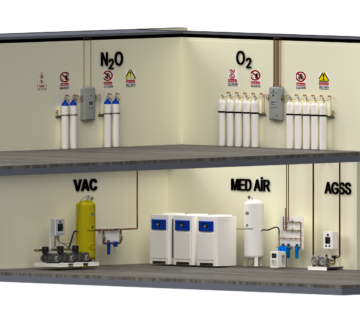
Medical gases can be primarily listed as oxygen, air, nitrogen, nitrous oxide, and carbon dioxide. Apart from these gases, Unimex systems also incorporate vacuum systems used for suction and anesthetic gas exhaust systems.
Oxygen
Oxygen, under normal conditions, constitutes about 21% of the air and is crucial for the survival of all living organisms. Oxygen is administered with a humidifier to patients experiencing respiratory difficulties or with a low SpO2 level. It is a vital gas connected to devices like anesthesia machines and ventilators, making it a critical component in all sections of a hospital.
In smaller hospitals, high-pressure oxygen is usually supplied through oxygen cylinders with manifolds used to reduce pressure. In larger hospitals, oxygen is provided in liquid form, converted to gas through evaporators. Some hospitals also use oxygen generation systems, although this technology is relatively new and still evolving.
During oxygen therapy, the gas must be filtered and humidified by a humidification bottle containing pure water. Failure to humidify can lead to throat dryness and allergies.
The abbreviation for oxygen is O₂. According to ISO 32 standards, it is represented in white, while in the American standard, it is shown in green. Oxygen is commonly used at a pressure between 4–5 bar in Europe and most parts of the world. In the United States, the pressure used is 345–380 kPa (3.45–3.8 bar).
Medical Air
Medical air is predominantly used in emergency, intensive care, and operating room units to support patients with respiratory difficulties. Unimex medical air systems ensure the air is thoroughly dried and filtered, free from oil, particles, moisture, and odor.
The most common designation for medical air is MA4, represented in black and white according to ISO 32 standards, while in the American standard, it is shown in yellow. The pressure range is typically 4–5 bar globally and 345–380 kPa in the United States.
Surgical Air
Surgical air, equivalent to nitrogen in pressure, dryness, and cleanliness but more cost-effective, is widely used in modern hospitals for operating surgical instruments, pneumatic systems, central sterile supply, and laboratory applications.
The most common designation is SA7. It is generally supplied via a separate regulation group through a 4-bar air plant. Surgical air operates at 7–8 bar globally and 700–800 kPa in the United States.
Nitrous Oxide
Nitrous oxide, commonly known as “laughing gas,” is used in anesthetic and analgesic procedures. It is colorless, non-combustible at room temperature, but becomes a strong oxidant at high temperatures.
It plays a significant role in dentistry and surgical operations and is included in the World Health Organization’s Essential Medicines List. Proper precautions must be taken during its use, and patient identification measures such as alert bracelets are recommended.
Nitrogen
Nitrogen is used in cryosurgery, preservation of biological materials, and pharmaceutical manufacturing. It is also used as a dry and clean gas source where compressed air is unavailable.
Unimex nitrogen supply systems typically use tube manifolds and are monitored through alarm systems integrated with hospital management systems for safety and reliability.
Carbon Dioxide
Carbon dioxide is used for insufflation in minimally invasive procedures such as laparoscopy, arthroscopy, and endoscopy, as well as for respiratory stimulation during anesthesia.
For efficiency and accessibility, Unimex systems recommend pipeline delivery in larger hospitals, while smaller facilities may rely on cylinder-based supply methods.

No comment